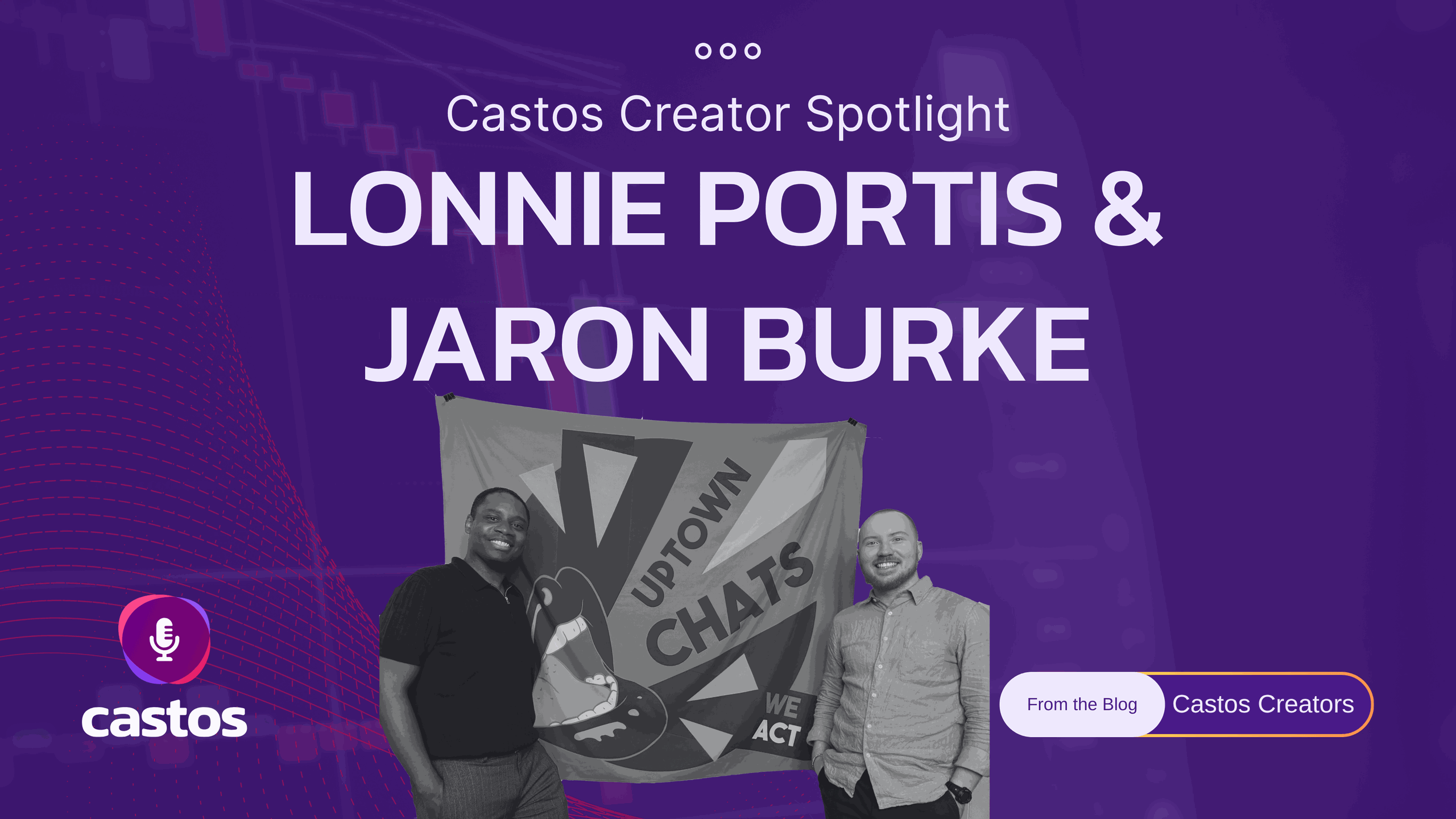
Castos Creator Spotlight: Jaron Burke and Lonnie Portis from Uptown Chats

The people behind great podcasts
The Castos Creator Spotlight celebrates the people behind great podcasts. Every two weeks, we feature creators in our community who are doing remarkable work, sharing their stories, their craft, and the passion that drives their shows.
The Podcast Greenlit By Accident
Jaron Burke and Lonnie Portis had been half-joking about starting a podcast for months, the kind of idea two coworkers keep circling back to without committing to it. Then one day they were goofing around about it in front of Peggy Shepard, the executive director of WE ACT for Environmental Justice. She overheard, loved it, and told them to go make the show. That was the entire green light.
Neither of them had touched a microphone before. Jaron had a little background with sound equipment and did around sixteen test recordings before they trusted the gear enough to hit record for real. Almost three years and 70-plus episodes later, Uptown Chats is New York City’s community-based environmental justice podcast, built specifically for people who aren’t academics or policy wonks: “everyday people,” in Jaron and Lonnie’s words, who live with these issues rather than study them.
WE ACT has spent 35 years organizing in northern Manhattan around one mission: making sure people of color and low-income residents have a real seat at the table when environmental health policy gets written. The podcast is one way that work can reach people who’ll never sit in a public hearing. Jaron and Lonnie call it a tasting menu, a monthly sampler of everything under the environmental justice umbrella (waste and sanitation, toxic beauty products, energy policy, housing, etc.) always with guests actually doing work on the ground, and always ending on the same question: what can you, the listener, go do about this right now?
Meet Jaron Burke and Lonnie Portis
| Go-to tool | Audacity |
| Consistency philosophy | Sketch out a rough topic outline for the whole year in advance, which gives more lead time to line up guests and write sharper questions |
| Using AI? | Not using it |
| In a year | Grow the NYC audience, host at least one more live show, and finally crack 500 listens on a single episode |
Jaron and Lonnie’s recording tip: “One of the most important changes we made in the last year was laying out a rough outline for what topics we wanted to cover each month for the upcoming year, which made it easier for us to reach out to our guests earlier. That gave us more time to develop better questions to ask our guests, and took off some of the pressure to come up with an episode topic as things got busy.”
A Miniseries That Outgrew Its Own Name
For their 50th episode, Jaron and Lonnie handed the mic over entirely, letting WE ACT’s chief of staff, Carla Cordero, interview them instead. It’s a good window into how the show runs: guests carry episodes, not just talking points. Their Wrong Direction miniseries, built around a WE ACT federal policy campaign, was supposed to be a handful of episodes on how federal energy policy was hurting environmental justice communities. It kept growing. “The Wrong Direction miniseries turned into a very not-so-miniseries,” Jaron admits, and by the time it wrapped they’d already committed to a companion Right Direction series on solutions, which he calls “very yin-yang energy.”
More recently, the show has been reaching past WE ACT’s own campaigns. A two-part book club episode built around Dr. Diana Hernandez’s book Powerless landed well enough that they’re considering making it a recurring format. Their newest two-parter, Solar and Storytelling, spends an episode with filmmaker Kiana Michaan on how climate and environmental justice actually show up (or don’t) in movies and TV, landing on the idea that any current-day story that ignores climate change is functionally science fiction. And in Deep Dive on Energy Justice, guest Eric Walker walks through how the Public Service Commission, the seven-person body that regulates every utility in the state, operates almost entirely outside public view. (“I will start giving away candy to anybody who can name three of the seven commissioners,” he offers, confident no one will collect.)
That episode also brushes up against the topic listeners keep asking for most: data centers. WE ACT is holding off on covering it until the organization settles its own position first, a small window into how deliberately they treat the show’s relationship to their advocacy. As Jaron puts it, the podcast runs on the organization’s work, but “collaborating with guests on episodes helps strengthen the relationship between our organizations” right back.
Looking Ahead
Jaron and Lonnie measure success in NYC listeners, not download charts: growing the audience across the city, doing at least one more live show, and hitting 500 listens on a single episode for the first time. They’re also leaning slightly past WE ACT’s own direct campaigns, bringing on topics like plastics and chemical recycling because listeners keep asking. Video is coming too, gradually, mostly as short clips for social media for now.
One experiment is still waiting for its first taker: a call-in hotline that Jaron and Lonnie plug at the end of nearly every episode since launching it in February. Whoever calls first gets bragging rights!
Listen to Uptown Chats
Ready to add a New York environmental justice podcast to your queue? Here’s where to find Jaron, Lonnie, and Uptown Chats:
- Website: uptown-chats.castos.com
- Apple Podcasts: Uptown Chats on Apple Podcasts
- Spotify: Uptown Chats on Spotify
- WE ACT for Environmental Justice: weact.org
Thank you, Jaron and Lonnie, for bringing environmental justice out of the hearing room and into the podcast feed. We can’t wait to hear where Uptown Chats goes over the next 70 episodes!
Launch Your Podcast In Minutes
Castos makes launching simple with one-click setup, automatic distribution to all platforms, and professional hosting. No technical skills required.
Start your 14-day free trial