How to Monetize a Podcast in 2026: Complete Guide

You can monetize a podcast at a few hundred downloads an episode. Affiliate income, listener support, and selling your own product or service all work at that size, and none of them need a sponsor to say yes first. Sponsorship is the path that needs scale: brands usually want 5,000 to 10,000 downloads before they will talk rates.
The common advice says to wait until you have 10,000 downloads before monetizing your show. But here’s the truth: that advice will keep you stuck forever while you watch others turn their shows into revenue-generating assets.
The reality is far more encouraging. The global podcast market is valued at $39.63 billion, with 584.1 million listeners worldwide. More importantly, there are multiple ways to monetize a podcast at every audience size, from your very first episode to shows with millions of downloads.
In this guide, you’ll discover 10 proven podcast monetization strategies organized by audience size, complete with real earnings data, implementation steps, and realistic timelines. Whether you have 50 listeners or 50,000, there’s a monetization method that works for your show right now.
Ready to turn your podcast into income?
Castos offers more monetization options than any other platform – dynamic ads, private podcasting, donations, and subscriptions all in one place. Start your 14-day free trial
Key takeaways
- You do not need 10,000 downloads to start. That number is a sponsorship threshold, not a monetization threshold, and treating it as a starting line costs most shows years of income.
- Affiliate marketing is the fastest first dollar. It needs no minimum audience, no sales calls, and no new product. Recommend what you already use.
- Sponsorship pays per thousand listens, everything else pays per relationship. A show with 400 committed listeners often out-earns one with 4,000 passive ones.
- Premium feeds beat ads at small scale. Twenty people paying $5 a month is $100, which is more than most shows earn from ads at 2,000 downloads an episode.
- Stack two or three streams, not eight. Every stream you add has a setup and maintenance cost, and the shows that burn out are the ones running all of them at once.
How Podcast Monetization Works
Podcast monetization happens when your listeners buy something and you get a cut. That’s it. The money comes from one of three sources:
- Direct sales: Selling your own products, services, or premium content
- Partner commissions: Earning a percentage when listeners buy from sponsors or affiliates
- Business profits: Using your podcast to build a business that generates revenue
Most successful podcasters don’t rely on a single revenue stream. They combine multiple monetization methods, which protects them from platform changes and creates more stable income. The timeline to meaningful revenue typically ranges from 3 to 12 months, depending on your approach and audience growth.
When Can You Start Monetizing Your Podcast?
Here’s where most advice gets it wrong. You don’t need to wait for arbitrary download numbers to start making money from your podcast.
The myth that you need 10,000 downloads before monetizing keeps creators from building revenue foundations early. While some monetization methods do require larger audiences (like traditional sponsorships), others work from episode one.
Here’s what’s actually possible at different audience sizes:
0-100 downloads per episode:
- Affiliate marketing (no minimum required)
- Your own products or services
- Email list building (foundation for future sales)
100-500 downloads per episode:
- Listener support and donations
- Small direct sponsorships from niche brands
- Basic merchandise sales
500-1,000 downloads per episode:
- Direct sponsorship outreach
- Premium content and memberships
- Platforms that run ads across old episodes
1,000+ downloads per episode:
- Multiple revenue streams working together
- Professional sponsorship rates
- Scaling strategies
The key is starting early with methods that match your current audience size, then adding more sophisticated approaches as you grow.
Get Paid for All Your Episodes with a Single Click
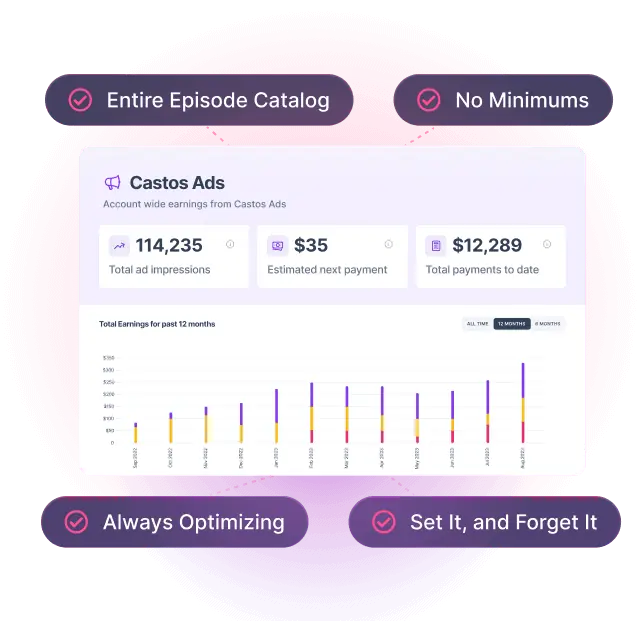
Castos lets you monetize all of your episodes – even the old ones – with a press of a button. We handle everything for you. That means no more chasing sponsors, negotiating deals, recording ad segments, or editing ads into episodes.
How do Castos Ads work?
Our platform will dynamically stitch short, brand-appropriate ads to the beginning and end of each episode. It’s all automatic. Your entire catalog will serve ads and earn money 24/7. There is ZERO technical setup needed from you.
Your episodes will only become one minute longer, but your smile will get a little wider as each listen adds more money to your monthly payout.
Get paid for every episode, no matter how old
Traditional sponsorship deals only apply to new episodes, but Castos Ads works with your entire library. Adding these ads to your show does not affect your rankings, ratings, or reviews on any of the podcasting directors and listening apps.
Ads are never stale or irrelevant
With dynamic ads, the ad content itself is always relevant. We never serve stale ads or ads for companies/products that don’t exist.
Great for new shows with small audiences
Most sponsors don’t want to talk to you until you have tens of thousands of listeners. That’s their loss! We will monetize your podcast even if you’ve literally just started. And we’ll keep paying you more as your audience grows.
Serve your own ads too
As your audience grows, sponsors will start to notice you. Using Castos Ads doesn’t prohibit you from including your own ads as well. Feel free to negotiate your own sponsorship deals and include them in your episodes. The sponsorship will give you a nice one-time cash bonus while Castos Ads will continue to pay you indefinitely.
Pause at any time, no questions asked
If you decide Castos Ads aren’t for you, simply pause the ads at any time in your dashboard. No questions asked. Ads will immediately cease on all episodes in your Castos account.
(But honestly, we don’t think you’ll want to pause. Everyone likes free money landing in their bank account without any effort!)
Start Making Money with Your Podcast
Flip the switch now and start making money from your show. You get that mic upgrade you’ve been eyeing or finally invest in an editor. Or treat yourself to a spa day. It’s your cash!
Zero setup. Turn on and off any time.
10 Proven Ways to Monetize a Podcast
1. Sponsorships and Advertising
Sponsorships are the most visible way podcasts make money, but they’re not always the best starting point for small shows.
How it works: Brands pay you to mention their products or services during your episodes. Rates are typically calculated using CPM (cost per thousand downloads), ranging from $20 for general audiences to $85+ for specialized niches.
According to industry data, host-read ads account for 55% of all podcast ad revenue because they feel more authentic than pre-recorded spots. In 2025, U. S. podcast advertising revenue reached $4.8 billion, making this a proven monetization model.
Requirements:
- Most brands want 5,000-10,000 downloads per month minimum
- Consistent publishing schedule
- Clear audience demographics
- Niche audiences often command higher CPM rates than mass-market shows
Implementation:
- Always include FTC disclosures if you’re based in the United Sates (required by law)
- Build a media kit showing your stats, audience demographics, and sample episodes
- Research brands that serve your niche
- Decide between direct outreach or joining an ad network (Midroll, AdvertiseCast, Podcorn)
- Negotiate rates and placement (pre-roll, mid-roll, post-roll)
Real numbers: With 20,000 downloads per episode and a $20 CPM, you’d earn $400 for a 60-second ad. Specialized niches like B2B tech or finance can command $50-85 CPM, meaning that same 20,000 downloads could generate $1,000-1,700 per ad. Run your own numbers through our free ad revenue calculator to see what your download count is worth at different CPMs.
Timeline: Expect 6-12 months to build the audience and credibility needed to attract quality sponsors.
Castos advantage: Use Castos Ads for one-click dynamic ad insertion. Update ads across all your episodes instantly, maximize CPM with strategic placement, and access built-in analytics that prove ROI to sponsors.
2. Listener Support and Donations
This strategy works at any audience size because it relies on engagement rather than raw numbers.
How it works: Your most loyal listeners contribute directly to support your show, either as one-time donations or recurring monthly support. In exchange, you might offer perks like shout-outs, bonus content, or early access to episodes.
The beauty of listener support is that even small audiences can generate meaningful revenue. If you have 100 engaged listeners and 5% decide to support you at $7/month, that’s $35 in recurring revenue. As one creator discovered, 312 supporters at $7/month generates $2,184 monthly before platform provider fees.
Why it works:
- Conversion rates typically range from 2-10% of your audience
- Works even with 50-100 loyal fans
- Low barrier to entry (set up in under an hour)
- Listeners feel like part of something special
Implementation:
- Choose a platform: Patreon, Buy Me a Coffee, Ko-fi, or use Castos Commerce
- Define your support tiers ($3, $7, $15/month are common)
- Create clear benefits for each tier
- Craft a compelling pitch explaining why you need support
- Mention support opportunities in episodes without being pushy
Real numbers: Industry data estimates that supporters contribute an average of $4.67-$10 per month. Even modest success creates reliable recurring revenue that grows as your audience expands.
Castos advantage: Castos Commerce builds donation functionality directly into your hosting platform. Accept one-time and recurring support without third-party fees, creating a seamless experience for your listeners while you keep more revenue.
Accept Donations From Your Listeners
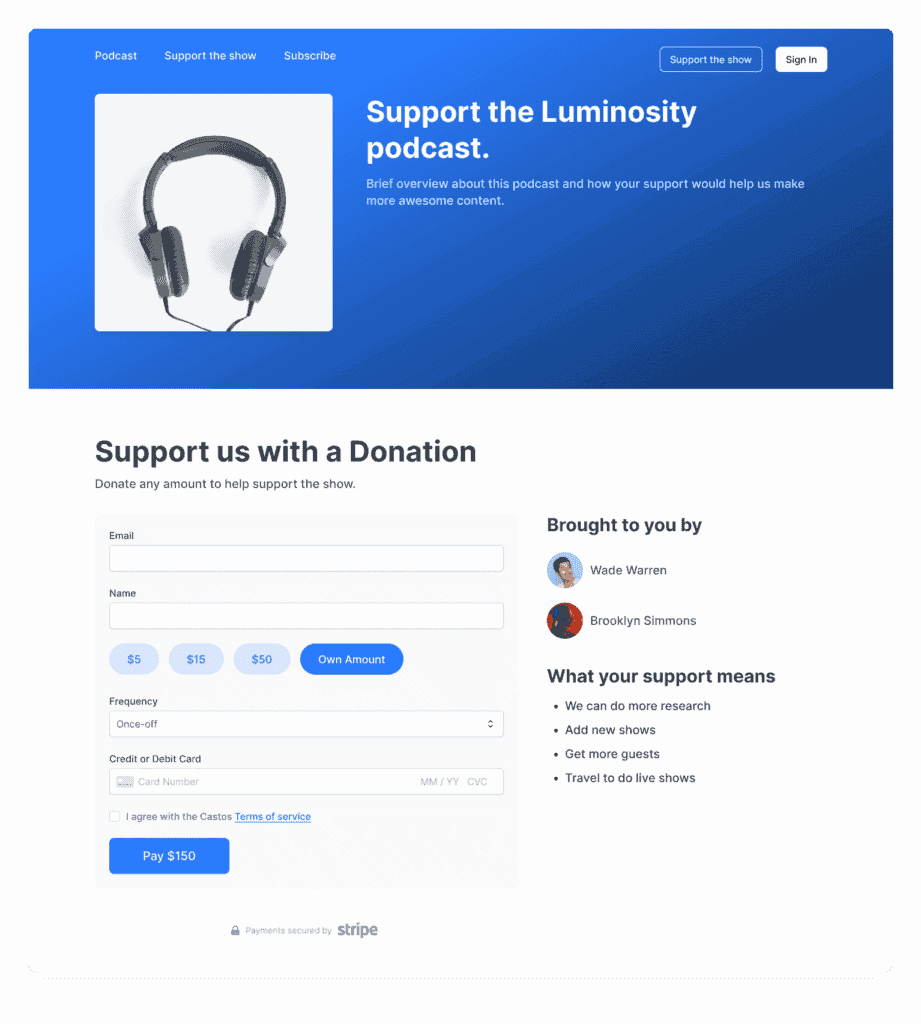
Unlock the full monetization potential of your podcast. Let your audience directly support your podcast through one-time or recurring donations with Castos Commerce.
How does Castos Commerce work?
Extra money in your wallet at the end of each month is as easy as 1-2-3.
- Connect to Stripe to handle the payment processing. This is completely free.
- Determine donation levels. They can be one-time, recurring, fixed amounts, or free form. You can decide what works best for your audience.
- Collect donations from listeners. All you have to do is let your audience know they can support you as a creator.
Does Castos take a cut?
Nope! Castos Commerce does NOT take a percentage of your revenue. Aside from the Stripe processing fee ($0.30 + 2.9%) everything else goes in your pocket. There are no hidden charges or obscure fees with Castos Commerce. It’s available to everyone on a paid Castos hosting plan, absolutely for free.
How do listeners donate?
Every Castos website hasis a checkout page that’s built for conversions. Easily accept payments right on your Castos podcast website. No coding or weird integrations necessary. Everything done-for-you, under one roof.
Furthermore, each supporter of your show has their own Subscriber Dashboard where they can manage their contributions, get receipts, and update payment details. In-depth analytics tell you who is supporting your show, how much they pledge, and where they come from.
Making Money Doesn’t Have to be Complicated
With zero transaction fees and customized checkout pages, accepting donations has never been easier. Create a direct listener experience for your show, and let your audience pay you directly as a creator.
Turn on and off any time.
3. Premium Content and Memberships
Subscription-based podcast content grew to 29% of all monetized shows in 2025, making this one of the fastest-growing monetization strategies.
How it works: You offer exclusive content behind a paywall. This might include bonus episodes, ad-free versions of your regular show, extended interviews, early access, or access to a private community. Listeners pay a monthly subscription fee, typically $5-15.
The membership model works especially well for shows with highly engaged niche audiences. If listeners already love your free content, a percentage will happily pay for premium access.
Market context: Apple Podcasts Subscriptions has made this strategy more accessible, and platforms like Circle, Podia, and Memberful have streamlined the technical setup. Some successful creators have built businesses generating $240,000+ annually from podcast memberships alone.
Implementation:
- Decide on your premium content model (bonus episodes, early access, extended cuts, behind-the-scenes)
- Choose your platform (Apple Podcasts Subscriptions, dedicated membership platforms, or Castos)
- Set your pricing (research competitors, but $7-10/month is a sweet spot for many shows)
- Create your first premium content before launching
- Promote to your existing audience (they’re most likely to convert)
Real numbers: With a 5% conversion rate, a podcast with 1,000 listeners would gain about 50 paying members. At $10/month, that’s $500 in monthly recurring revenue, or $6,000 per year.
Castos advantage: Use Private Podcasting for secure, password-protected feeds, or try Hybrid Podcasting for a free-plus-paid content model. Integration with Apple Podcasts Subscriptions makes setup seamless, and you can even offer a custom branded app for your premium subscribers.
4. Affiliate Marketing
If you’re wondering how to monetize a small podcast, affiliate marketing is your answer. This is the best start immediately strategy because it has no audience size requirement.
How it works: You promote products or services you genuinely use and love. When listeners make purchases through your unique affiliate link, you earn a commission. The beauty of affiliate marketing is that it’s performance-based with zero risk. No sales means no payment to you, but also no cost to try.
Why start here:
- Works from your first podcast episode
- No minimum audience requirement
- Builds revenue while you’re growing your audience
- Authentic recommendations actually build trust with listeners
Companies offering affiliate programs relevant to podcasters include Amazon Associates (4-10% commission), podcast equipment retailers (often 5-15%), and software tools (sometimes offering recurring commissions). Even niche products can generate substantial income when you have an engaged audience.
Implementation:
- Make a list of the products and services you actually use and recommend
- Join relevant affiliate programs (start with 3-5 to keep tracking manageable)
- Get your unique affiliate links
- Mention products naturally in your content when relevant
- Always disclose affiliate relationships (FTC requirement)
- Track which products convert so you can optimize over time
Real numbers: Commission rates vary dramatically. Amazon typically pays 4-10%, but specialized products can pay 20-50%. One podcaster with a mid-sized show reported earning $1,000+ monthly from affiliate marketing by focusing on a few high-quality recommendations that truly helped her audience.
Timeline: You can make your first dollar within 30-90 days if you’re actively promoting products your audience needs.
Best practices: Only promote what you actually use, explain specifically why you recommend it, provide value beyond just the affiliate pitch, and always include clear affiliate disclosures.

5. Your Own Products and Services
This monetization method offers the highest profit margins because you keep 100% of the revenue (minus payment processing fees, of course).
How it works: Your podcast becomes the marketing channel for your business. This might include digital products like courses, ebooks, or templates, services like coaching or consulting, or even physical products related to your expertise.
The power of this approach is that your podcast naturally positions you as an expert and builds trust over time. When listeners need help in your area of expertise, you’re the obvious choice.
Types of products that work:
- Digital courses: $97-$997+ (platforms: Udemy, Teachable, Thinkific)
- Coaching or consulting: $100-$500/hour
- Ebooks and guides: $7-$47
- Templates and tools: $19-$99
- Workshops and masterclasses: $47-$297
- Speaking engagements: $2,000-$10,000+
Why it’s powerful:
- You keep 100% of profit (minus small payment processing fees)
- Builds your email list and customer base
- Creates an asset that can scale beyond the podcast
- Positions you as the authority in your niche
Implementation:
- Identify your expertise and what your audience needs most
- Create your minimum viable product (don’t wait for perfection)
- Build an email list from your podcast (offer a free resource to get subscribers)
- Use your podcast episodes to demonstrate your expertise and value
- Integrate soft-sell mentions naturally (avoid being pushy)
Real numbers: If you build an email list of 1,000 subscribers from your podcast and create a $197 course, a 2% conversion rate generates $3,940 in revenue. Podcast audiences often convert at higher rates than cold traffic because the show has already established trust and familiarity.
Timeline: Creating a quality digital product typically takes 2-3 months, but the revenue potential makes it worthwhile for many creators.
6. Merchandise
Merchandise serves two purposes: generating revenue and building community around your brand.
How it works: Sell branded products to your fans. Print-on-demand services eliminate inventory risk, meaning you only pay for items after they’re ordered. Your listeners get tangible products that show their support, and you earn profit on each sale.
When it makes sense:
- You have 500+ engaged listeners
- Strong brand identity, logo, or catchphrases
- Visual podcast artwork that translates well to products
- Community-oriented show where fans want to represent
Implementation:
- Choose a platform: Teespring, Printful, or Shopify for more control
- Design 3-5 product options to start (t-shirts, hoodies, mugs, stickers)
- Set up your store (takes 1-2 hours with print-on-demand)
- Promote organically in episodes (mention 1-2 times per episode)
- Feature customer photos and testimonials
Real numbers: Profit margins for print-on-demand merchandise typically range from $5–15 per item after the platform’s cut. With a 1–3% conversion rate, a podcast with 1,000 listeners might sell around 20 items per month. At a $10 profit per item, that adds up to roughly $200 per month in extra revenue.
Merchandise won’t make you rich, but it’s a nice supplementary income stream that also strengthens your community and increases brand visibility.
7. Repurposing Content for Multiple Platforms
Here’s a monetization strategy many podcasters overlook: taking your audio content and turning it into multiple revenue streams.
How it works: Your podcast episodes contain valuable content that can be repackaged for different platforms and audiences. The most obvious example is YouTube, where video podcasts are experiencing explosive growth. Under the Partner Program, creators on YouTube typically earn in the range of $0.002–$0.03 per view (or about $2-$30 per 1,000 views), depending on niche, geography, ad break placement, and other factors.
Beyond YouTube, you can create blog posts from transcripts (monetized with display ads), LinkedIn newsletters, Medium articles, or compile episodes into ebooks that you sell.
Implementation:
- Enable YouTube Republishing through Castos for automatic syndication
- Create blog posts from episode transcripts with display ads
- Cut your episodes into short clips for social media promotion
- Compile episodes into ebooks or courses
- Repurpose on multiple platforms to maximize reach
Castos advantage: Automatic YouTube republishing means every episode you publish automatically becomes a video on YouTube, exposing your content to a massive new audience and creating a new revenue stream with zero extra work.
Real numbers: At a $1.50 CPM, a video podcast with 10,000 monetized views would earn about $15. With consistent publishing, that can still become meaningful supplementary income.

8. Consulting and Speaking Opportunities
Your podcast naturally positions you as an expert in your field. Smart podcasters leverage this authority to command higher fees for consulting and speaking.
How it works: As your show grows, you’ll start receiving inquiries from people who want to work with you directly or hire you to speak at events. Your podcast serves as an extended audition, demonstrating your expertise and communication skills.
Implementation:
- Add a “Work with me” page to your podcast website
- Mention your availability for consulting or speaking in your podcast intro or outro
- Network with conference and event organizers in your industry
- Create a speaker one-sheet highlighting your podcast stats and speaking topics
Real numbers:
- Consulting: $100-$500/hour depending on your expertise and niche
- Speaking engagements: $2,000-$10,000 per event
Some business podcasters report that their shows lead directly to paid speaking opportunities. In one case, a host booked three engagements in her first year, earning about $15,000 in additional income.
9. Live Events and Workshops
Creating live experiences lets you monetize deeper relationships with your most engaged fans.
How it works: Host in-person or virtual events like masterclasses, workshops, networking sessions, or meet-and-greets. Revenue comes from ticket sales, and you can also add sponsors or sell merchandise at these events.
Implementation:
- Virtual events: Use Zoom or Hopin (lower barrier to entry, global reach)
- In-person events: Usually requires 1,000+ listeners in a specific geographic area
- Ticket pricing: $27-$297 depending on format and value delivered
- Bonus revenue: Add sponsors and sell merchandise at events
Real numbers:
- Virtual workshop: 20 attendees × $47 = $940
- In-person event: 100 tickets × $97 = $9,700
Live events require significant effort but create memorable experiences that deepen listener relationships and often open new opportunities. Podcasting also complements live events exceptionally well, extending their impact beyond the room.

10. Join a Podcast Ad Network
For established shows with consistent performance, podcast networks offer professional ad sales in exchange for a revenue share.
How it works: Networks like Midroll, AdvertiseCast, or Podcorn handle sponsor relationships and ad sales for you. They take 30-50% of ad revenue but bring professional sales teams and established brand relationships.
Requirements:
- Typically need 10,000+ downloads per episode
- Consistent content quality and publishing schedule
- Proven track record (usually 6-12 months minimum)
Benefits:
- Professional sales team working for you
- Established relationships with major brands
- Less time spent on business development
Networks make sense when your time is better spent creating content than selling ads, and when the network can command higher CPMs than you’d get alone.
How to Choose Your Monetization Strategy
Not every monetization method makes sense for every podcast. Here’s how to choose what works for your show right now.
Consider your audience size:
- Under 500 downloads: Focus on affiliate marketing, your own products, and listener support
- 500-1,000: Add premium content and small direct sponsorships
- 1,000-5,000: Pursue larger sponsorships while maintaining diverse revenue streams
- 5,000+: All methods are available, focus on optimizing and scaling
Think about engagement vs. size: A highly engaged niche audience of 300 listeners can generate more revenue than 3,000 passive listeners. Technical topics and B2B niches often command higher CPMs and better conversion rates for products and services.
Evaluate your time and resources:
- Low time investment: Affiliate marketing, dynamic ads through platforms
- Moderate time: Listener support, merchandise
- High time investment: Creating digital products, hosting live events
Match your goals:
- Passive income: Affiliate marketing, automated ad insertion, merchandise
- Active income: Coaching, consulting, workshops
- Business building: Your own products and services, building an email list
- Diversified approach: Combine 2-3 methods for stability
Recommended progression:
- Months 0-6: Affiliate marketing and email list building
- Months 6-12: Add listener support or premium content
- Months 12-18: Pursue sponsorships or launch your own products
- Months 18+: Multiple revenue streams working together, optimize based on data
Avoid These Common Monetization Mistakes and Set Your Podcast Up for Success
Use these insights to strengthen your monetization strategy and set your show up for long-term success.
- Start early: You don’t need huge download numbers to begin. Building your monetization foundation early—even with small wins—creates momentum.
- Pace your ads: Thoughtful pacing keeps listeners engaged. Begin with 1–2 sponsors and pay attention to retention so you can grow sustainably.
- Promote authentically: Recommend products you genuinely believe in. Authenticity builds trust, and trust is what makes monetization work.
- Build your email list: Your email list is an asset you own. Start collecting subscribers from day one to deepen your relationship with your audience.
- Diversify income streams: A mix of revenue sources helps you stay resilient if platforms or sponsor budgets change.
- Use clear calls to action: Guide listeners on how to support you or access your offerings. Make it simple, natural, and consistent.
- Lean on analytics: Let data show you what’s working. Tracking results helps you fine-tune your strategy and grow with confidence.
Timeline: What to Expect
Here’s what realistic podcast monetization looks like over time.
Months 1-3: Foundation
- Focus: Creating quality content, building email list
- Monetization: Set up affiliate marketing
- Expected revenue: $0-$100/month
- Key metric: Email subscriber growth
Months 4-6: Early Revenue
- Focus: Consistent publishing, audience engagement
- Monetization: Affiliate sales, first listener support
- Expected revenue: $100-$500/month
- Key metric: 100-500 downloads per episode
Months 7-12: Diversification
- Focus: Premium content creation, approaching small sponsors
- Monetization: Multiple streams becoming active
- Expected revenue: $500-$2,000/month
- Key metric: 500-1,000 downloads per episode
Months 13-24: Scaling
- Focus: Optimizing existing streams, direct sponsorships, products
- Monetization: Mature revenue streams, professional sponsors
- Expected revenue: $2,000-$5,000+/month
- Key metric: 1,000-5,000 downloads per episode
Remember, these timelines are general averages, not hard rules. Niche shows with highly engaged audiences often outperform these numbers, while broader, mass-market podcasts may take longer to generate consistent revenue. Some podcasts may not be ready to monetize right away due to factors like audience fit, content maturity, or clarity of value. Every show grows at its own pace, and the most effective monetization strategy is the one aligned with your niche, your goals, and your audience’s needs.
How Castos Helps You Monetize Your Podcast
At Castos, we’ve built the most complete podcast monetization platform in the industry because we’re committed to helping creators turn their passion into sustainable income.
Castos Ads: Our one-click dynamic ad insertion system lets you add, update, or remove ads across all your episodes instantly. Maximize your CPM with strategic ad placement (pre-roll and post-roll), and access built-in analytics that prove ROI to sponsors. No technical skills required.
Castos Commerce: Accept listener support and donations directly through your hosting platform. Offer one-time or recurring support options, keep more of your revenue by eliminating third-party fees, and create a seamless experience for your supporters.
Private and Hybrid Podcasting: Create premium content with password-protected feeds, build free-plus-paid content models with Hybrid Podcasting, integrate seamlessly with Apple Podcasts Subscriptions, and even offer a custom branded mobile app for your premium subscribers.
YouTube Republishing: Automatically syndicate every episode to YouTube with our republishing feature. Tap into video monetization, reach new audiences, and maximize your content ROI with zero extra work.
Analytics That Sell: Castos analytics provide the data sponsors want to see. Track downloads, listener demographics, and episode performance all in one place. Build compelling media kits that command higher CPM rates.
Everything works together in one platform, so you can spend less time juggling tools and more time creating great content.
Explore how Castos’s monetization features can help you turn your podcast into a revenue-generating asset.
FAQs about podcast monetization
How many listeners do you need to monetize a podcast?
For sponsorships, most brands want 5,000 to 10,000 downloads per episode before they will negotiate. For everything else there is no minimum. Affiliate links, listener donations, premium feeds, and selling your own services all work from your first episode, and small engaged audiences convert far better than large passive ones.
How long does it take to make money from a podcast?
Most shows earn their first affiliate or listener-support income within three to six months of consistent publishing. Sponsorship money typically arrives somewhere between month nine and month eighteen, once download numbers are stable enough to quote to a brand. Shows selling their own product or service often move fastest, because the audience does not need to be big, only the right people.
How much do podcasts make per 1,000 downloads?
Host-read sponsorship rates generally run $18 to $25 CPM for a mid-roll spot and $15 to $18 for a pre-roll, so 1,000 downloads is roughly $18 to $25 per ad slot. Programmatic and dynamically inserted ads pay less, often $8 to $15. Niche shows in expensive verticals like finance or B2B software regularly clear $50.
Can you monetize a podcast on Spotify and Apple Podcasts?
Both offer paid subscriptions, but each locks your premium listeners into that one app and takes a cut. Running premium content through your own host keeps the audience, the payment relationship, and the email addresses with you, and your private feed still plays in whatever app the listener already uses.
What is the easiest way to start making money from a podcast?
Affiliate marketing. Pick two or three products you genuinely use and already mention on the show, sign up for their affiliate programs, and put the links in your show notes with a clear disclosure. There is no minimum audience, no pitching, and nothing to build.
Start Monetizing Your Podcast Today
You don’t need 10,000 downloads to start making money from your podcast. You don’t need to wait until everything is perfect. You just need to choose one monetization method that matches your current audience size and get started.
Here’s your action plan:
This week:
- Choose 1-2 monetization methods to implement first (we recommend starting with affiliate marketing)
- Set up affiliate accounts for products you already use and recommend
- Add an email signup form to your podcast website
- Review FTC disclosure requirements for any sponsored content
This month:
- Create a simple media kit if pursuing sponsorships
- Set up listener support through Castos Commerce or a platform like Patreon
- Plan your first premium content offering
- Outline a product or service you could create based on your expertise
This quarter:
- Launch your first monetization method
- Track revenue and what’s working
- Add your second revenue stream
- Evaluate performance and optimize based on data
Remember, monetizing your podcast isn’t about getting rich overnight. It’s about building sustainable income doing work you love while serving an audience that values what you create. Your listeners want to support you, so make it easy for them.
The podcasters making money in 2025 aren’t the ones waiting for permission or perfect conditions. They’re the ones who started small, stayed authentic, and grew strategically. That can be you.
Ready to turn your podcast into a revenue-generating asset?
Ready to turn your podcast into a revenue-generating asset?
Try Castos free for 14 days and access all the monetization tools you need to start making money from your show.
Launch Your Podcast In Minutes
Castos makes launching simple with one-click setup, automatic distribution to all platforms, and professional hosting. No technical skills required.
Start your 14-day free trial