Podcast Production in 2026: What 99 Creators Told Us About Recording, Editing, and Video

We’ve been curious how Castos creators are actually using video. The conversation has been building for years, and Apple’s HLS support has only made it louder. But is video something most podcasters are doing now, or is it still selective? Are people building separate video workflows, or is the camera just on because the remote recording tool makes it easy? The trend pieces weren’t answering those questions.
So in March 2026 we surveyed Castos creators about their production workflow: how they record, how they edit, and whether they’re making video. We were hoping for 100 responses. We got 99. We’re fine.
How Podcasters Record Their Episodes
Remote recording platforms are the most common podcast production setup. Riverside, Zoom, SquadCast, and similar tools dominate the responses. Local software (Audacity, GarageBand, Adobe Audition) comes second, usually used alongside a remote platform rather than instead of one. A meaningful share use physical hardware: mixers, Rodecaster, dedicated recorder hardware.
A few comments stood out. One creator records in-person interviews with elderly veterans and relies on 32-bit float capture to handle fragile audio. Another uses Restream to go live on YouTube, Twitch, and Kick simultaneously and treats the audio output as the podcast episode. The paths into recording are more varied than any tool shortlist captures.
If you’re still figuring out your own setup, our guide on how to record a podcast covers workflow and best practices from the first episode forward.
The Most Popular Podcast Editing Tools
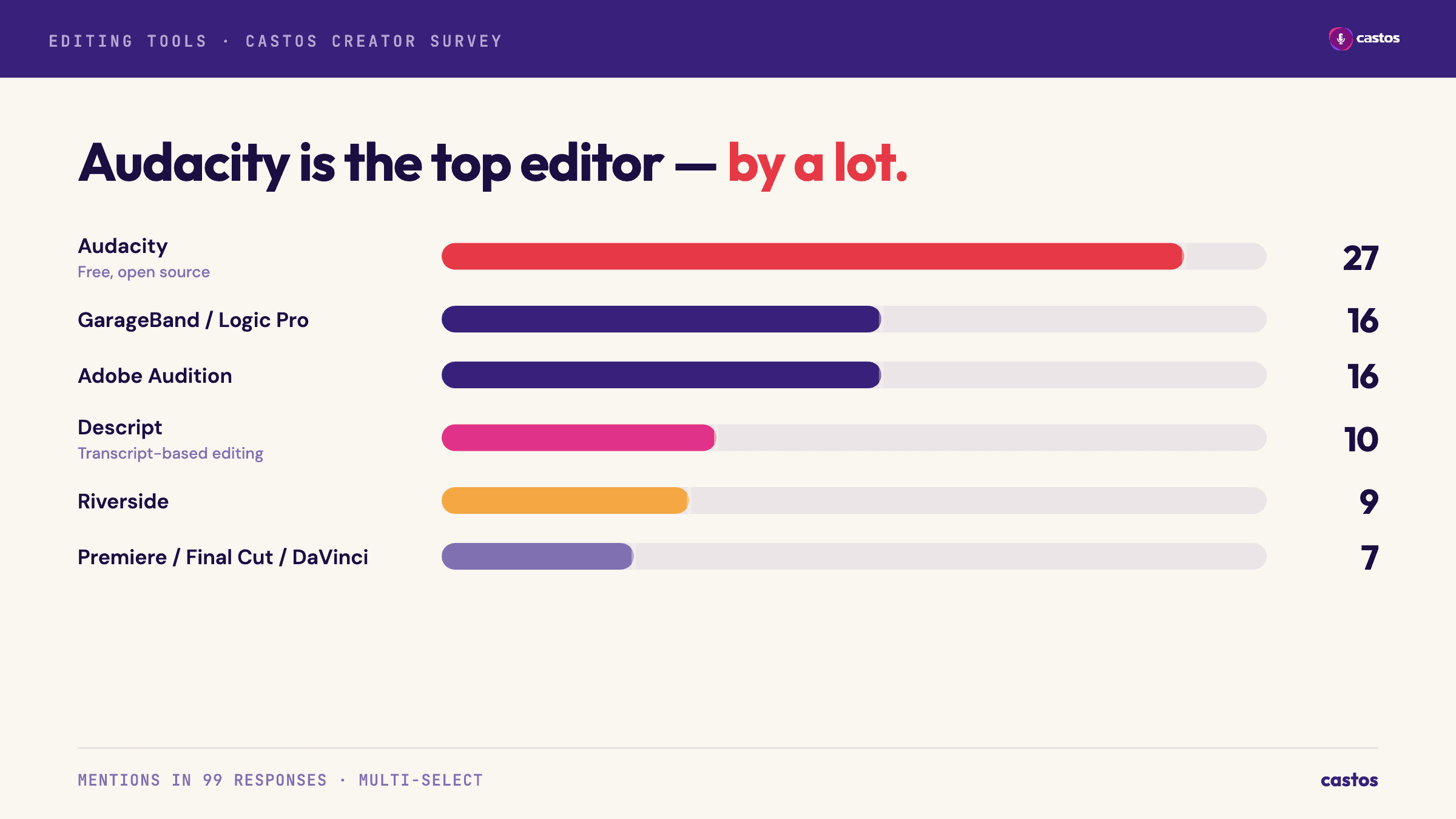
Audacity is the top editing tool by a significant margin. Adobe Audition and GarageBand/Logic Pro follow, tied for second. Descript has a real foothold; several creators use it as their primary editing environment, often because of its transcript-based workflow.
A handful outsource editing entirely. “I pay someone to do it” and “you edit our podcast for us” both showed up in the responses. A few use professional software: Pro Tools, Reaper, DaVinci Resolve. Several mentioned they do minimal editing or none at all.
The range is wide. Some creators are working in pro DAWs with hardware mixers. Others hit record, skip editing, and upload. Both approaches show up in the same survey.
If you’d rather hand editing off entirely, Castos Productions offers a podcast editing service for creators who want professional post-production without doing it themselves.
Are Podcasters Going Video? The Data
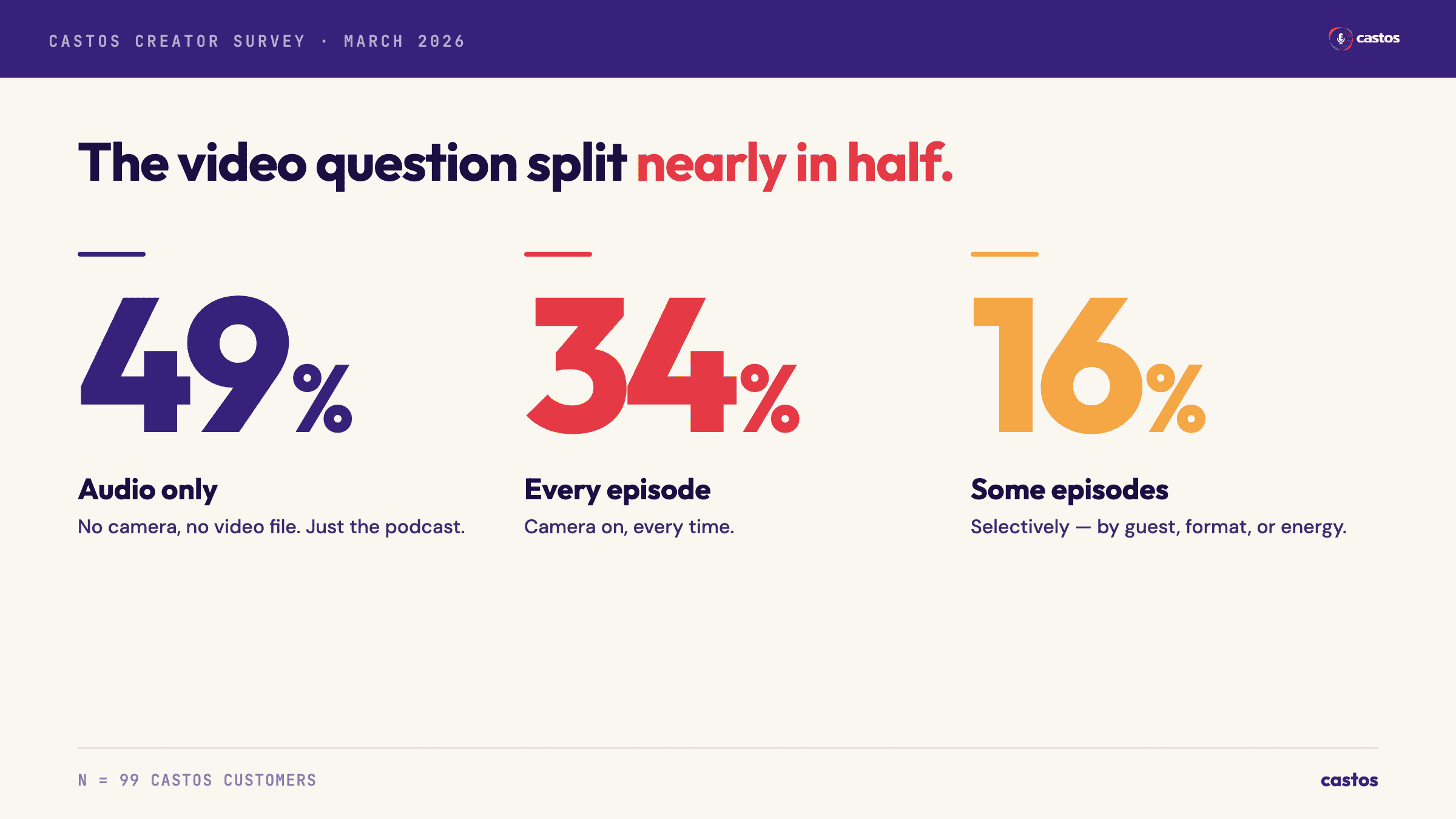
This was the question we were most curious about. The answers split almost exactly in half.
- 49% don’t record video at all. Audio only, no camera.
- 34% record video for every episode. Camera on, every time.
- 16% record video for some episodes. Selectively, based on guest, format, or energy level.
The even split makes sense once you look at who’s recording each way. Most of the “every episode” group are interview-format shows where a guest remote recording is already happening through Riverside or Zoom. The video is essentially free. Most of the audio-only group are solo shows, narrative formats, or creators who made a deliberate choice to keep production simple.
This split tracks with a broader truth about video podcasting: it’s not a universal upgrade. Whether to go video depends more on your format and distribution goals than on any industry trend. The data shows both approaches are well-represented, and both are defensible.
Where Video Podcast Creators Are Publishing
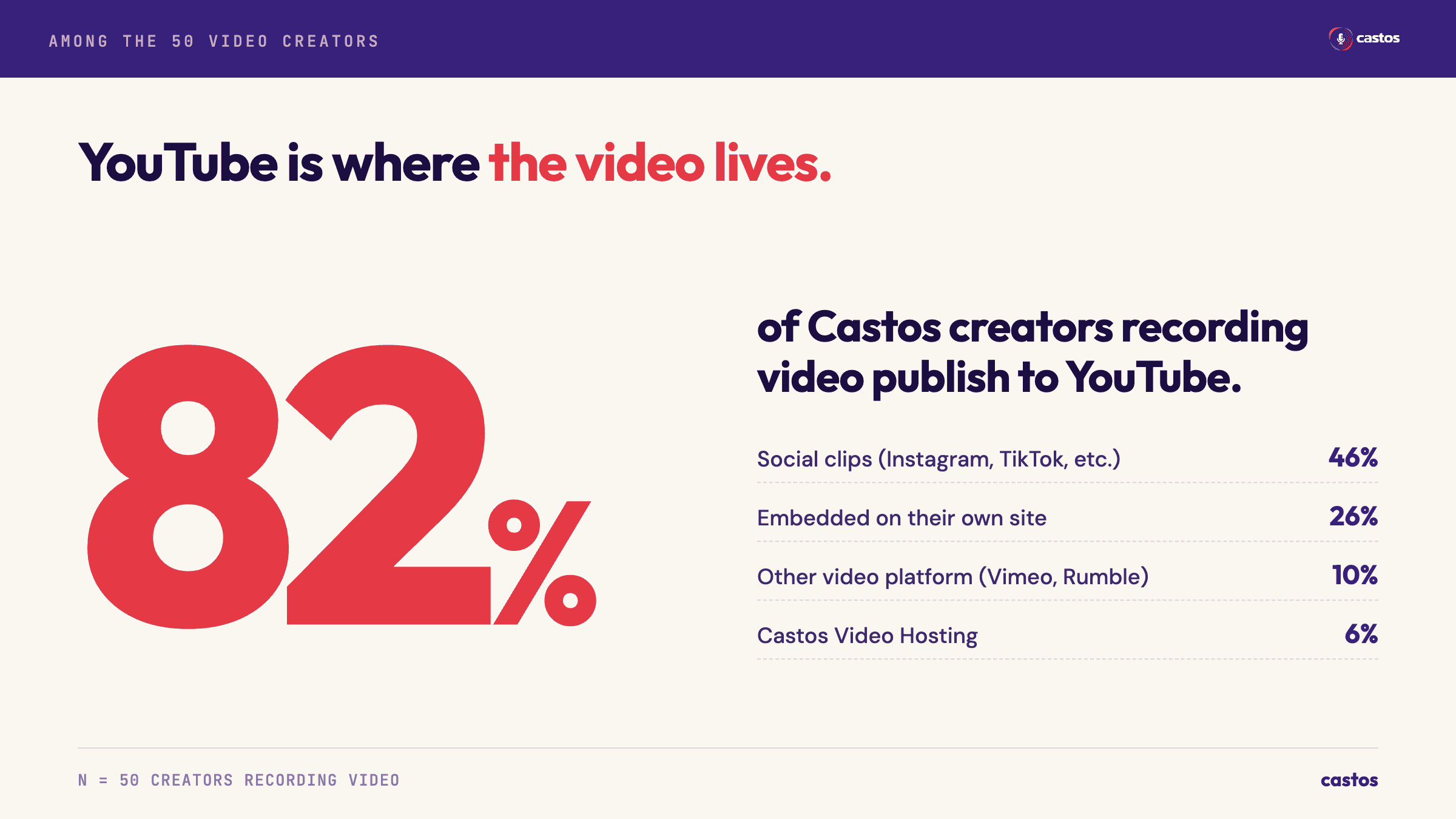
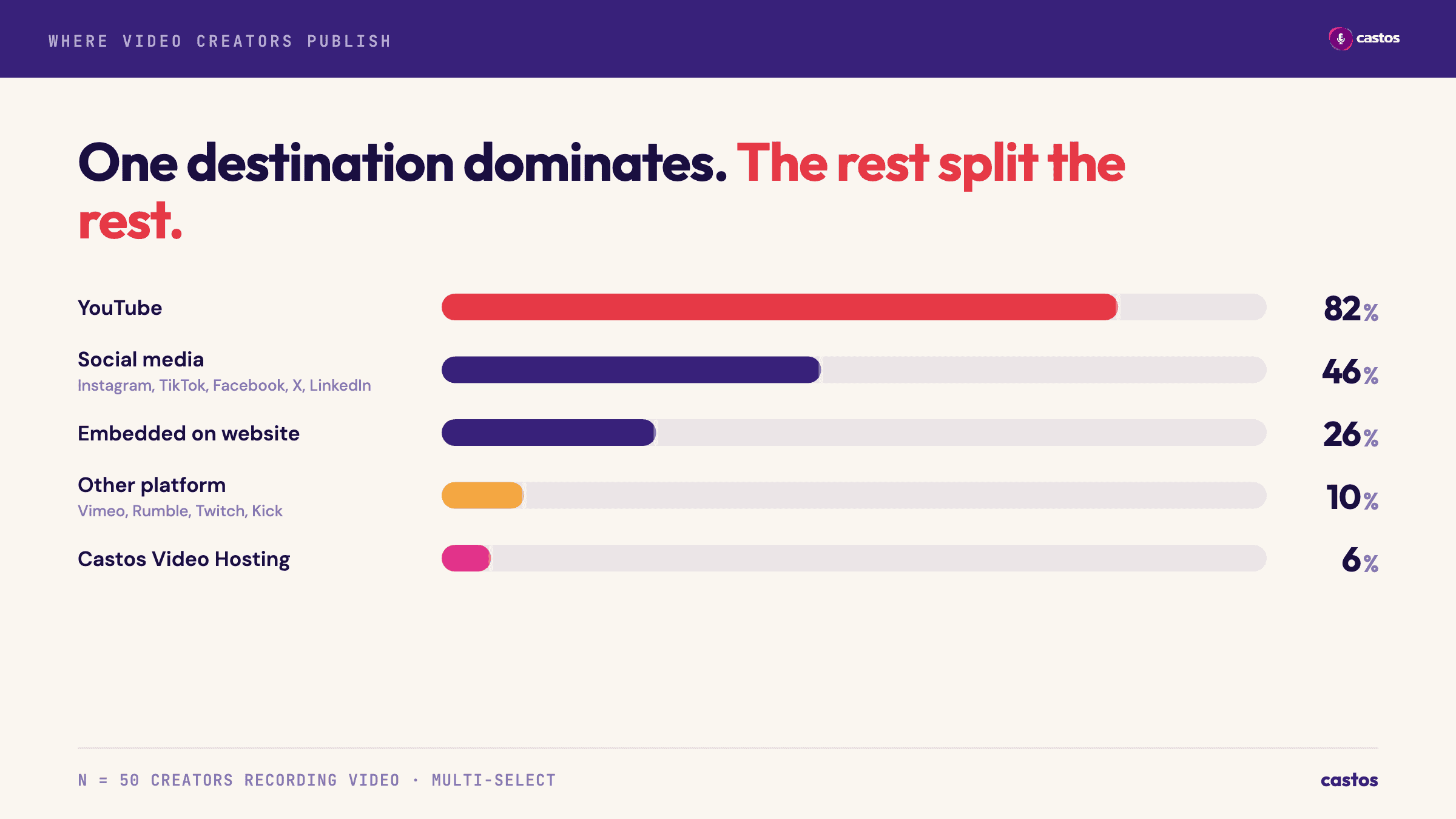
Of the creators who record video, YouTube is the dominant destination. 82% publish there. Social clips (Instagram, TikTok, Facebook) come second, with 46% of video creators posting clips to social platforms. A smaller number embed video on their own site or use Castos video hosting directly to distribute to video podcast directories that support video in RSS feeds.
A few responses stood out. One creator goes live on YouTube first, then uploads the audio to Castos after the stream ends. Another records video but only publishes audio; the camera is there for conversation quality, not distribution. One creator noted the complexity involved and that adding video “greatly increased my workflow.”
If you’re already publishing audio to Castos and want to add YouTube distribution, the YouTube republishing feature can push your episodes there automatically from your hosting dashboard, without a separate upload step.
Would Podcasters Pay for Built-In Recording and Editing?
The survey was partly about a Castos product direction: a built-in recording and editing tool integrated into the hosting platform. We asked directly whether creators would pay for it.
About half said “maybe, depending on the features and price.” Just over 40% said no outright. A small share said yes definitely.
The “no” answers are worth reading closely. Several came from creators who are deeply invested in specific tools (Pro Tools, DaVinci Resolve, Adobe Audition) and have no reason to switch. Others use free tools like Audacity and don’t want to add a monthly cost. The concern that kept coming up: don’t add features and raise the price for everyone.
The “yes” and “maybe” answers pointed at a specific gap. Multiple creators mentioned using Riverside but finding it unreliable, unstable, or bloated with features they don’t need. One creator said they wish Riverside would “stop adding features and fix the existing ones.” Another, who left Castos for another host, said they’d consider returning if we built something comparable but more reliable.
What Podcast Creators Said They Actually Want
A few themes from the open-ended responses:
- Simpler, not more powerful. “Just reliable remote recording” came up more than once. The frustration wasn’t with features per se. It was with tools that prioritize new features over fixing core functionality.
- API and automation access. At least one creator flagged the lack of API access in remote recording tools as a blocker for AI-driven workflows. As AI tools become part of the podcast production process, the ability to connect tools programmatically is increasingly important.
- Accessibility. One creator who is blind noted that any recording tool needs to be screen-reader compatible. This is a real and underserved need in audio software.
- Streaming and recording in one. Several creators livestream and podcast from the same session using Streamyard or Restream and want that capability in a single tool.
- Don’t make me pay twice. Several creators said they’d rather have the feature included in their current plan than pay an additional monthly fee.
What’s Coming for Video in Podcast Production
Podcast apps have historically been audio-first, but that’s been changing for the last few years now.
A major podcast platform is adding HLS support for podcast feeds. HLS is the streaming standard most video platforms already use. The practical result: video can travel through podcast RSS the same way audio always has, into podcast apps, without requiring YouTube as the required intermediary. And most importantly: this will be done with the same RSS feed used for audio episodes.
We’re building HLS support at Castos to match this, along what is already available for native video-in-RSS: the ability to include a video file directly in your podcast feed so platforms that support it can play video.
For creators already publishing video to YouTube, this opens a new distribution path. Your video podcast could reach podcast app listeners without a separate workflow. It won’t replace YouTube for most shows. But it means video content can move through the podcast ecosystem on its own terms, via RSS, the same infrastructure that has always powered podcast distribution.
We’ll share more details when these features are ready.
Key Takeaways
- Recording: Remote platforms (Riverside, Zoom, SquadCast) are the dominant setup for podcast production. Hardware and local software remain common, often in combination.
- Editing: Audacity leads by a significant margin among Castos creators. Descript has a real foothold for interview-format shows.
- Video: The split is nearly 50/50 between audio-only and video. Format and workflow drive the decision more than industry trends.
- Distribution: Of video creators, 82% publish to YouTube. Social clips and website embeds are secondary destinations.
- What creators want: Reliability over features. The gap isn’t a full recording suite. It’s a remote recording tool that works consistently.
If you’re hosting your podcast on Castos, see everything that’s included in your plan, including YouTube republishing and the video distribution features coming soon.
Survey conducted March 2026. 99 Castos customers responded.
Launch Your Podcast In Minutes
Castos makes launching simple with one-click setup, automatic distribution to all platforms, and professional hosting. No technical skills required.
Start your 14-day free trial