Podcast Advertising Rates in 2026: CPM Benchmarks by Format, Placement and Category

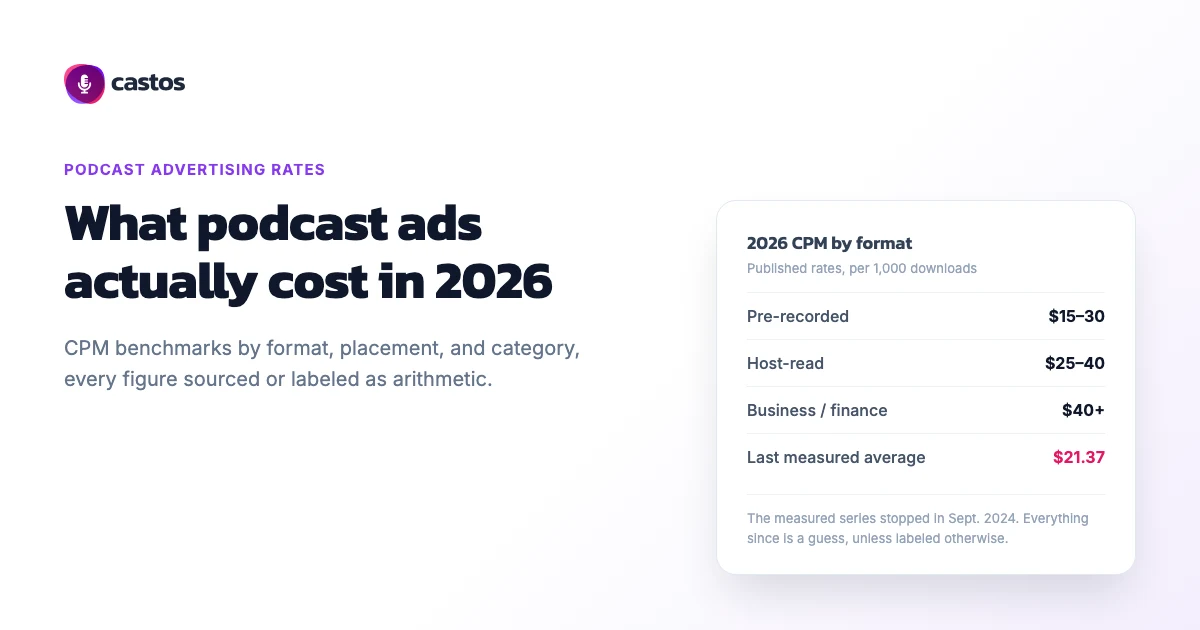
Pre-recorded podcast ads run $15 to $30 CPM in 2026 and host-read sponsorships $25 to $40, according to Acast’s published rate guidance. Business, finance and B2B shows clear $40. Work that through for a show with 5,000 downloads an episode and one ad slot, and you get somewhere between $75 and $200 per episode.
That is the short answer. The longer one matters more, because the number most articles quote is older than it looks.
Updated September 2026. Every figure below carries a numbered reference to its source, listed in full at the foot of the page.
Where podcast rate data actually comes from in 2026
For four years the industry had one honest number. AdvertiseCast, later rebranded Libsyn Ads, published a monthly average CPM drawn from real transactions in its marketplace. It was not a survey or a projection, it was what advertisers actually paid.
That series ended. The final edition reported an average CPM of $21.37 for a 60-second spot in September 2024, published by Libsyn, barely moved from $21.36 the month before and down from $22.84 in September 2023. Nothing has replaced it.
So when you read a “2026 average podcast CPM” anywhere, it is one of three things: a network’s published floor, arithmetic derived from that dead Libsyn series, or a guess. Worth knowing before you build a rate card on it.
What we do have is solid enough to price against:
- Network published rates, which are real but are minimums rather than averages
- The final Libsyn marketplace data, which is a genuine measured average, just two years stale
- Category splits from that same data, which reflect advertiser economics rather than market conditions
Everything below comes from one of those. Where a number does not exist in a published source, this page leaves the cell empty rather than filling it with an estimate.
2026 podcast CPM benchmarks by format
Who voices the ad sets the price more than anything else on this page.
| Ad format | CPM |
|---|---|
| Pre-recorded, up to 60 seconds | $15 - $30 [1] |
| Host-read sponsorship | $25 - $40 [1] |
| Host-read, business / finance / B2B | $40+ [1] |
| 60-second spot, all formats blended | $21.37 [2] |
Host-read carries a premium because it performs better. Nielsen measured 71% brand recall for host-read ads against 62% for announcer-read spots [3], and advertisers price that gap in.
CPM by placement
Where the ad falls in the episode is the second lever.
| Placement | Position in episode | Relative price |
|---|---|---|
| Pre-roll | First 10% | Below mid-roll [1] |
| Mid-roll | Around the 40-60% mark | The most expensive of the three [1] |
| Post-roll | Final 10% | The most affordable of the three [1] |
No current public source measures placement rates separately, so this table gives the order and no dollar figures. Anything you see quoted per placement elsewhere is derived from the discontinued Libsyn series rather than observed.
If you want a defensible placement premium, negotiate from your own show’s completion rate, which your podcast analytics will tell you.
CPM by category
This is the table most creators skip, and it moves rates more than download count does.
| Category | Average CPM |
|---|---|
| Government | $31 [2] |
| Technology | $29 [2] |
| Health & Fitness | $24 [2] |
| Kids & Family, Sports, History | High teens to low $20s [2] |
No comparable category data has been published since.
The logic is advertiser economics, not audience quality. A sponsor selling expensive software can pay $29 to reach a thousand technology listeners and still profit on the ones who convert. A sponsor selling a low-priced consumer product cannot pay the same and make the maths work. None of that is a judgment on your show. It is the arithmetic on the other side of the deal, and it is why category belongs at the top of your rate card conversation.
What your show can earn
Straight CPM arithmetic [4]: downloads multiplied by CPM, divided by 1,000, times four episodes a month, one ad slot per episode.
| Downloads per episode | At $15 CPM [1] | At $21.37 CPM [2] | At $40 CPM [1] |
|---|---|---|---|
| 1,000 | $60 / mo | $85 / mo | $160 / mo |
| 5,000 | $300 / mo | $427 / mo | $800 / mo |
| 10,000 | $600 / mo | $855 / mo | $1,600 / mo |
| 25,000 | $1,500 / mo | $2,137 / mo | $4,000 / mo |
| 50,000 | $3,000 / mo | $4,274 / mo | $8,000 / mo |
Selling two slots roughly doubles it. Selling your back catalogue through dynamic ad insertion adds downloads that already happened to the total, which is the single biggest lever most creators leave alone.
Run your own numbers with the podcast advertising calculator.
What determines your rate
Five things, roughly in order of how much they move the number:
- Category. See above. A $10 spread between categories showed up in the last measured data.
- Format. Host-read starts where pre-recorded tops out.
- Placement. Mid-roll commands the premium.
- How you sell. Direct deals keep the whole fee. Networks and marketplaces take a commission in exchange for filling inventory you would not have filled yourself, and the rate varies by network, so read the agreement.
- Download count. It sets your total, not your CPM. Scale gets you access to bigger advertisers rather than a better per-thousand rate.
Audience engagement belongs on that list too, but only if you can evidence it. Completion rate, repeat listenership and email list size all give you something concrete to argue with when a sponsor opens at their floor.
CPM, flat fee, or a hybrid
CPM is the default, not the only option, and for smaller shows it is often the worst of the three.
CPM suits shows big enough that a per-thousand rate produces a sensible invoice, and big enough to clear whatever download minimum a network or marketplace sets.
Flat fee suits everyone below that. Run the arithmetic on a small show and you can see why: 800 downloads at the last measured average of $21.37 values a slot at about $17, which is not worth either party’s paperwork. The same sponsor may happily pay considerably more for a season-long read in front of exactly the buyers they want. Price the audience, not the arithmetic.
Hybrid and affiliate deals put a floor under you and give you upside: a smaller flat fee plus a per-sale commission or a unique discount code. They also generate the conversion data that justifies a higher rate at renewal, which makes them a good first deal even when the headline number looks modest.
If you are not yet talking to sponsors at all, start with how to get podcast sponsors, and read the complete guide to podcast ads for how the formats and networks fit together. The definitions behind every term here live in the podcast advertising glossary.
Frequently asked questions
How much do podcast ads pay?
On a CPM basis, $15 to $30 per thousand downloads for pre-recorded spots and $25 to $40 for host-read sponsorships in 2026, higher in business and finance (Acast). A show with 5,000 downloads an episode therefore earns roughly $75 to $200 per slot per episode.
How much do podcast ads cost?
From the buying side, $15 CPM at the low end for pre-recorded inventory and $25 CPM upward for host-read (Acast). Reaching 50,000 downloads works out at $750 to $1,250 per placement before platform or agency fees. Mid-roll costs the most, post-roll the least.
What is a good podcast CPM?
The last measured marketplace average was $21.37 for a 60-second spot (Libsyn, September 2024). For pre-recorded inventory, at or above that is competitive. Host-read should price higher, and if it is not, you are underselling it.
How much do sponsors pay for podcasts?
Direct sponsors either pay your CPM or a flat fee per episode or season. Flat fees are common on smaller shows and are usually the better deal there, because they price the audience rather than its size.
How many downloads do you need to sell podcast ads?
Networks and marketplaces each set their own download minimum, so check the one you are applying to rather than trusting a general figure. Selling direct, or running your own inventory through built-in dynamic ad insertion, removes the floor entirely.
Why do podcast CPM rates vary so much by category?
Because they track what a sponsor earns back per listener. In the last measured data, Government averaged $31 CPM and Technology $29, while Kids & Family, Sports and History sat in the high teens to low twenties (Libsyn).
Is there a current industry average podcast CPM?
Not a measured one. The monthly marketplace series that provided it ended in September 2024 at $21.37, and no organisation has replaced it. Current figures published anywhere are either network floors or estimates built on that last data point.
Article Sources
Castos uses primary sources, industry standards bodies and original research, to support the facts in our guides.
- Acast. “How much does podcast advertising cost? CPM rates 2026.” Published starting rates, which are floors rather than averages. Accessed September 9, 2026. acast.com.
- Libsyn. “September 2024 Podcast Ad Rates.” Measured marketplace averages, and the final edition of that monthly series before it was discontinued. Accessed September 9, 2026. libsyn.com.
- Nielsen. “Host-Read Podcast Ads Pack a Brand Recall Punch.” Accessed September 9, 2026. nielsen.com.
- Castos calculation, derived from sources 1 and 2 rather than survey data: downloads ÷ 1,000 × CPM × 4 episodes per month, one ad slot per episode.
Launch Your Podcast In Minutes
Castos makes launching simple with one-click setup, automatic distribution to all platforms, and professional hosting. No technical skills required.
Start your 14-day free trial