Best Podcast Monetization Platforms in 2026: Fees, Ad Tools and Subscriptions Compared

Most “best podcast monetization platform” comparisons rank hosts on storage limits and analytics. Those are hosting features. What decides how much money reaches your bank account is narrower: whether the platform can insert ads into your back catalog, whether it can charge your listeners directly, and what it keeps on the way through.
Here are the three that stand out, for different reasons:
- Castos if most of your revenue will come from your listeners. Donations and paid subscriptions both run at a 0% platform cut, and Castos Ads fills pre-roll and post-roll inventory with no minimum audience.
- Podbean or Captivate if you want a marketplace where you pick and approve individual sponsorship deals.
- Spotify for Creators if you are video-first and want free hosting, accepting that Spotify keeps half of the ad revenue it monetizes.
Updated September 2026. Every price and feature below was checked against the platform’s own pricing and feature pages on 10 September 2026. Platforms change these often, so we recheck quarterly.
Podcast monetization platforms compared
| Platform | Entry paid plan | Dynamic ad insertion | Paid subscriptions / premium feeds | Ads sold for you | Published cut on your revenue |
|---|---|---|---|---|---|
| Castos | $19/mo | All plans, pre-roll and post-roll | Private paid subscriptions, private feeds on all plans | Castos Ads, automatic fill, no minimum audience | 0% on donations and subscriptions, Stripe 2.9% + $0.30 only |
| Buzzsprout | $15/mo | Pre-roll and post-roll only | Buzzsprout Subscriptions, Apple Podcasts Subscriptions | Buzzsprout Ads | Not published |
| Podbean | $12/mo | Yes | Apple Podcasts Subscriptions | PodAds Ads Marketplace, $1 CPM on lower tiers, free on Network | Not published |
| Captivate | €17/mo | Yes, “AMIE” | Memberships, tipping, private podcasting | Captivate Marketplace | Not published |
| Libsyn | $12/mo | Enterprise plan only, custom pricing | Apple Podcasts Subscriptions, every plan | Libsyn Ads, plus host-read ad sales representation | Not published |
| Transistor | $19/mo | From the $49 Professional plan | Private podcasts, as access control rather than billing | No | Not applicable |
| RSS.com | Free tier, Plus $15/mo | Programmatic insertion from Plus | Apple Podcasts Subscriptions from Plus, donations and Value for Value on Free | Programmatic ads | Revenue share on video ads at the Max tier, percentage not published |
| Spotify for Creators | Free | No, ads are sold by Spotify | Subscriptions on Spotify, or connect Patreon or Substack | Spotify Partner Program | 50% of ad revenue Spotify recognizes |
Prices are the entry paid tier at each vendor’s advertised billing terms, which for several means annual billing. Captivate prices in euros.
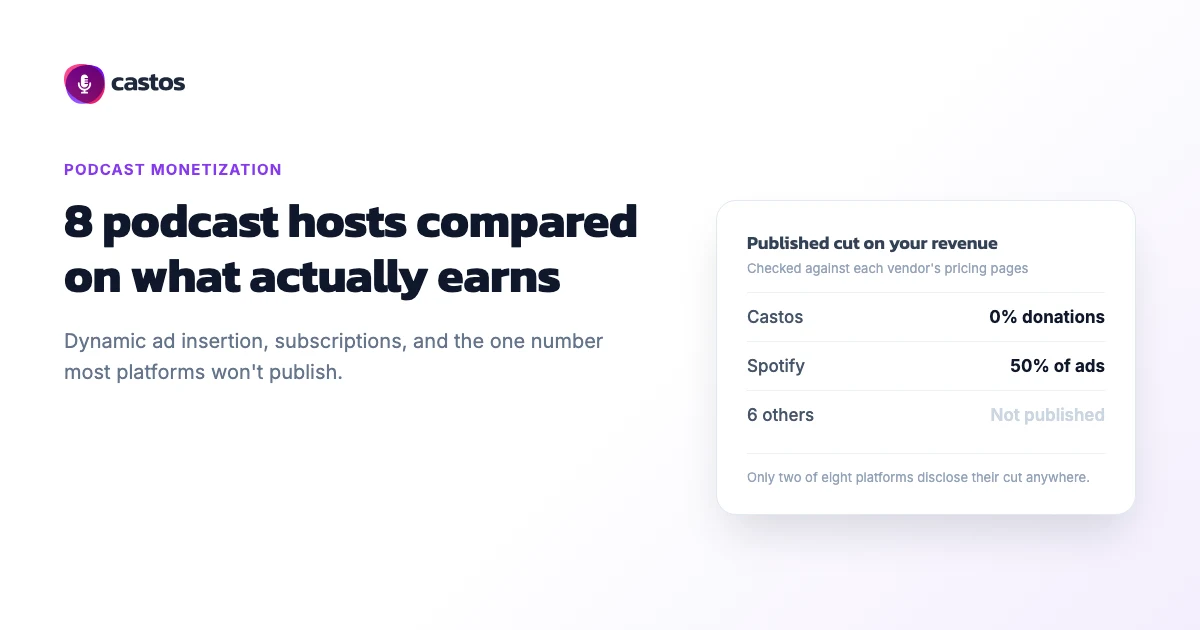
The most useful column is the last one, and it is mostly empty. Only Castos and Spotify put a number on what they keep, Podbean publishes a $1 CPM charge for its marketplace, and the rest disclose no revenue share, commission or transaction fee anywhere on their pricing pages. Castos states 0% for listener revenue, covering both donations and paid subscriptions, but does not publish a payout rate for Castos Ads the way Spotify publishes its 50% ad share. That is not an accusation of anything; marketplaces price per deal and terms vary. But if you are choosing a platform on the basis of what you will keep, in most cases you cannot find that out until you are inside the product, and that includes the ad side of ours.
What each platform is actually best at
Castos: keeping listener revenue
Castos Commerce handles one-off and recurring donations and states plainly that it “does NOT take a percentage of your revenue,” leaving Stripe’s $0.30 + 2.9% as the only deduction. That same 0% extends to paid subscriptions: Castos charges no platform fee and no per-subscriber fee inside your plan’s subscriber limit, only Stripe’s standard processing fee applies. Private paid subscriptions and private feeds are included on paid plans, with feeds scaling from 100 subscribers on Essentials to 500 on Pro. Castos Ads fills inventory automatically with no minimum audience, paying per listen, which is unusually open for a built-in ad product.
One gap is worth naming. Castos Ads and Castos Campaigns insert pre-roll and post-roll, not mid-roll, so the highest-value placement is one you sell and insert yourself. And unlike Spotify’s published 50% ad-revenue share, Castos doesn’t publish a payout rate for Castos Ads, only that it pays per listen.
Of the eight, Buzzsprout leans hardest into simplicity.
Subscriptions, Listener Support and Buzzsprout Ads are all built in and easy to switch on, but Dynamic Content covers pre-roll and post-roll segments only, the same placement limit Castos has on its own hosting-native tools. Mid-roll on either platform means selling and inserting it yourself.
Podbean is the cheapest way into a real ad marketplace.
PodAds is built in, and Podbean is unusual in publishing a price for it: $1 CPM on the lower tiers, free once you’re on the $79 Network plan. Entry pricing here is the joint lowest of the eight.
Captivate packs the widest spread of tools onto one plan.
Dynamic insertion through AMIE, its own marketplace, memberships, tipping and private podcasting all sit on the same platform, with none of it gated to a higher tier. Worth checking the euro pricing against your currency before you commit.
Libsyn’s ad product leans on human representation rather than self-service.
Automatic Podcast Ads and PodRoll are open on every plan, and Libsyn’s team says it “connects you with high-quality brand partners” for host-read deals, closer to an agency relationship than a self-serve marketplace. Libsyn also states it has paid out over $112 million to creators since 2017. What isn’t on the $12 entry plan is self-serve dynamic ad insertion, the tool for running your own sponsor spots across your back catalog; Libsyn gates that behind a custom Enterprise plan you have to contact sales for.
Transistor is built for multi-show teams who sell their own ads.
Dynamic ads cover pre, mid and post-roll, but only from the $49 Professional plan. Transistor is explicit that it expects you to bring your own monetization, pointing users toward running their own ads or a Patreon rather than offering built-in billing.
RSS.com has the softest landing of the eight.
A genuinely free tier comes with listener donations and Value for Value built in. Programmatic ads and Apple Podcasts Subscriptions arrive once you move to the $15 Plus plan.
Spotify for Creators: free hosting, paid for in revenue share
The Spotify Partner Program pays a 50% share of the ad revenue Spotify recognizes when its ads play in your episodes, on and off Spotify, plus payouts tied to Premium video engagement. Thresholds dropped in January 2026 to 1,000 engaged listeners and 2,000 consumption hours over 30 days, with 3 episodes published all time, and shows must earn at least $10 in any six-month period to stay eligible.
Choosing by revenue model, not by feature list
The right platform follows from which of the three revenue models you are actually going to run.
If you are selling ads to sponsors yourself, what matters is dynamic ad insertion covering mid-roll, and how early in the pricing it appears. Podbean and Captivate include it from their entry plans. Libsyn and Transistor gate it to a higher tier, Libsyn behind a custom Enterprise plan and Transistor behind its $49 Professional plan. The hosting-native tools at Castos and Buzzsprout cover pre-roll and post-roll, so mid-roll there is something you insert yourself.
If you want ads sold for you, the options split in two. Marketplaces where you approve individual deals, at Podbean, Captivate, Libsyn and Buzzsprout, and automatic fill that runs without you, at Castos and Spotify. Castos Ads is the only one of these with no minimum audience, though all of them pay on download volume, so a small show sees modest amounts either way. Our podcast advertising rates benchmarks show what the arithmetic looks like at different audience sizes.
If your audience is small but committed, listener revenue beats advertising, and the platform’s cut becomes the whole question. A 30% marketplace commission on subscriptions is the difference between a side income and a rounding error, which is exactly why we built Castos Commerce and private subscriptions to charge 0% beyond Stripe’s processing fee.
Most established shows end up running two of the three. For how the models fit together, see our guide to monetizing a podcast, and the complete guide to podcast ads for the advertising side in detail. If you are comparing these platforms on hosting rather than monetization, our podcast hosting comparison covers that ground instead.
Frequently asked questions
What is the best podcast monetization platform?
It depends which revenue stream you are building. For keeping the most of what listeners pay you, Castos takes 0% on both donations and paid subscriptions, and fills ads automatically with no minimum audience. For a built-in ad marketplace, Podbean and Captivate both run their own. For free hosting with video monetization attached, Spotify for Creators pays a 50% share of the ad revenue it recognizes.
Which podcast hosts have dynamic ad insertion?
Castos, Podbean and Captivate include it on every plan. Libsyn and Transistor gate it to a higher tier: Libsyn behind a custom Enterprise plan, Transistor behind its $49 Professional plan. On placement, Podbean, Captivate, Libsyn and Transistor cover mid-roll, while the hosting-native tools at Castos and Buzzsprout insert pre-roll and post-roll only.
What cut do podcast platforms take from monetization?
Most do not publish it. Of the eight platforms compared here, only Castos states a figure for listener revenue (0% on both donations and paid subscriptions, with Stripe’s processing fee the only deduction) and only Spotify states one for ads (a 50% share of revenue it recognizes). Podbean publishes a $1 CPM charge for its Ads Marketplace on lower tiers. The rest disclose no revenue share, commission or transaction fee on their pricing pages.
Can you monetize a podcast with a small audience?
Yes, but not usually through ad marketplaces, which price on volume. Listener support and paid subscriptions work at small scale because they price the relationship rather than the download count, which is why the platform’s cut on that revenue matters more than its ad tooling when you are starting out.
Does Spotify for Creators pay podcasters?
Through the Spotify Partner Program, creators earn a 50% share of the revenue Spotify recognizes when an ad it monetizes plays in their episodes, on and off Spotify, plus payouts tied to Premium video engagement. Since January 2026 the thresholds are 1,000 engaged listeners on Spotify and 2,000 consumption hours in the last 30 days, with 3 published episodes all time.
Do I need to switch hosts to start monetizing?
Not always. Apple Podcasts Subscriptions are supported across most of these platforms, and services like Patreon work alongside any host. Switching matters when you want mid-roll dynamic insertion your current host does not offer, or when you want to stop paying a commission on listener revenue.
Launch Your Podcast In Minutes
Castos makes launching simple with one-click setup, automatic distribution to all platforms, and professional hosting. No technical skills required.
Start your 14-day free trial